Why Choose Investment Casting Lost Wax for Your Projects?
Investment Casting Lost Wax has become a preferred method for various industries seeking precision and quality. Experts in the field, like Dr. Emily Carter, highlight its benefits. She states, "Investment Casting Lost Wax allows for intricate designs and high dimensional accuracy." This statement captures the essence of why this technique is gaining traction.
In the realm of manufacturing, the details matter. The Investment Casting Lost Wax process can produce complex shapes with minimal waste. It often involves a precise mold-making process that requires skill and expertise. However, challenges arise, such as ensuring temperature control and material consistency. These factors can impact the final output, requiring careful monitoring throughout production.
Despite its advantages, not every project may benefit from Investment Casting Lost Wax. The initial costs can be higher, and lead times may vary. It's essential for companies to weigh these factors before making a decision. The complexities of this casting method demand a thoughtful approach, making expert guidance invaluable.

Benefits of Investment Casting Using Lost Wax Technique
Investment casting using the lost wax technique offers numerous advantages for various projects. This process allows for intricate and precise designs. It can create complex geometries that traditional methods struggle to replicate. The fine details captured through this method result in high-quality products.
Another benefit of the lost wax technique is the excellent surface finish it provides. Parts often require minimal machining after casting. This can save time and reduce costs. The durability of investment cast components is impressive. They can withstand extreme conditions, making them suitable for industrial applications.
However, not every project is a perfect fit for investment casting. The initial setup can be costly. Creating wax patterns and molds requires skilled craftsmanship. Some projects may not justify this investment. Careful consideration is essential when choosing this method. Understanding your specific needs and budget will lead to better decisions.
The Process of Investment Casting: Step-by-Step Overview
Investment casting, particularly using the lost wax method, involves precise steps that yield high-quality results. This technique begins with creating a wax pattern, which is a replica of the desired metal part. A recent study indicated that about 80% of industries prefer investment casting for its accuracy and surface finish (Miller, 2022). Once the wax pattern is ready, it is coated with a ceramic material. This coating process enhances the mold's strength and heat resistance.
After the coating hardens, the wax is melted and removed, hence “lost wax.” The mold is then heated, preparing it for molten metal. This stage requires careful monitoring of temperatures. According to the American Foundry Society, investment casting allows for tighter tolerances—typically as close as ±0.5% of the dimension. Following pouring, the metal solidifies inside the mold. This method minimizes waste, as most of the metal utilized becomes the final product, in alignment with sustainable manufacturing practices.
Post-casting, the molds are broken to retrieve the finished parts. This step can be labor-intensive, and sometimes imperfections arise from residual material. It emphasizes the need for stringent quality checks to ensure that parts meet the specifications. This process is not without challenges. Variations in temperature or mixing can lead to defects, which must be addressed for optimal performance.
Why Choose Investment Casting Lost Wax for Your Projects? - The Process of Investment Casting: Step-by-Step Overview
| Step |
Description |
Materials |
Applications |
| 1 |
Wax pattern creation |
Wax |
Jewelry, intricate designs |
| 2 |
Shell building |
Ceramic materials |
Auto parts, aerospace components |
| 3 |
Wax removal |
Heat treatment |
Gas turbine parts, valves |
| 4 |
Melt metal pouring |
Various metals (steel, aluminum) |
Heavy machinery, industrial equipment |
| 5 |
Cooling and solidification |
N/A |
Medical devices, military components |
| 6 |
Finishing operations |
Various finishing tools |
Consumer products, art pieces |
Applications of Lost Wax Investment Casting in Various Industries
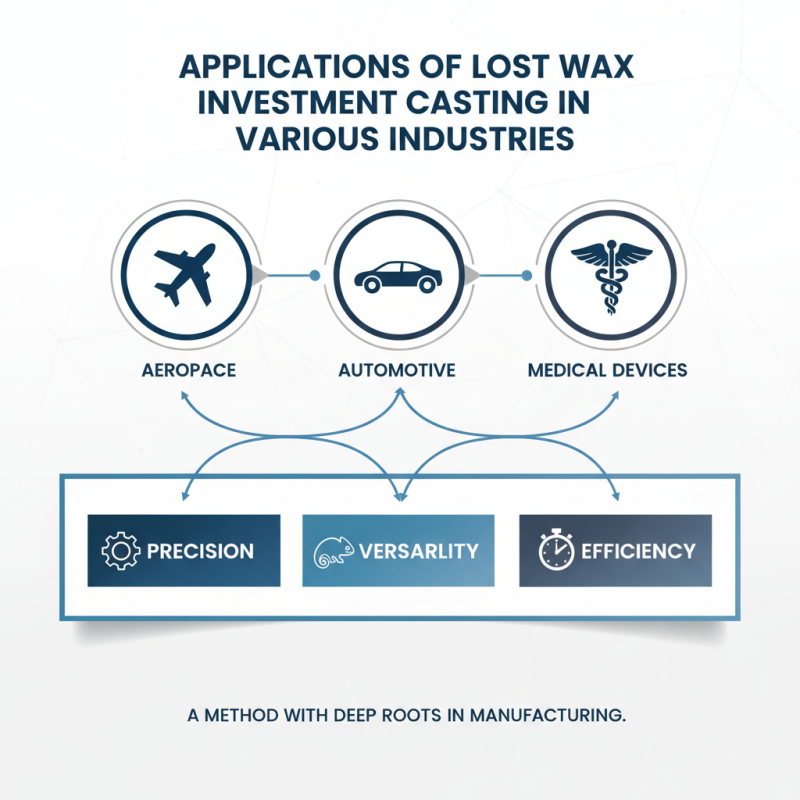
Lost wax investment casting, a method with deep roots in manufacturing, serves various industries effectively. This technique shines in sectors such as aerospace, automotive, and medical devices. Each application showcases its strengths: precision, versatility, and efficiency.
In aerospace, components must meet rigorous safety standards. Investment casting provides intricate shapes that traditional methods cannot achieve. The lightweight parts reduce fuel consumption and improve overall performance. In the automotive industry, lost wax casting creates durable engine components. These parts not only enhance vehicle reliability but also contribute to improved emissions.
Tips: Consider the design complexity before choosing this method. Ensure your project aligns with the casting capabilities. Always collaborate with experienced foundries for optimal results. Medical devices benefit greatly from this precision. The FDA regulations ensure that using investment casting leads to safe, reliable products. Maintaining quality assurance is critical. Engage with engineers to refine designs and avoid costly errors.
Comparative Advantages: Investment Casting vs. Other Methods
Investment casting, particularly the lost wax method, offers unique advantages compared to other manufacturing techniques. One key benefit is precision. Reports indicate that investment casting can achieve tolerances as tight as ±0.005 inches. This precision minimizes the need for extensive machining, which saves time and effort. For industries like aerospace and automotive, such accuracy is crucial, as even slight deviations can lead to performance issues.
Another advantage lies in material versatility. Investment casting supports a variety of metals. According to findings from industry studies, around 90% of metal alloys can be processed using this method. This allows for the creation of complex shapes that other methods struggle to replicate. For example, delicate features and intricate designs are easily achievable, enhancing both aesthetics and functionality in final products.
However, investment casting does have limitations that require careful consideration. The initial tooling costs can be high. For small production runs, the cost-effectiveness diminishes. Additionally, producing larger pieces can pose challenges; the heat treatments required may lead to warping. Such factors should be evaluated based on project needs. Prioritizing the right method is essential for successful outcomes.
Cost Efficiency and Quality in Investment Casting Projects
Investment casting, particularly the lost wax process, offers significant cost efficiency without sacrificing quality. According to industry reports, companies can save up to 30% on production costs compared to traditional machining methods. This is critical for projects with tight budgets. The precision of investment casting ensures minimal waste, which further drives down costs.
However, achieving top quality can be challenging. Flaws may arise from poor wax patterns or inadequate melting techniques. Regular quality checks and methodical wax pattern inspections are essential. Companies should prioritize employee training to mitigate these risks.
Tips: Always validate your suppliers' material certifications. This small step helps avoid costly mistakes. Also, consider using simulation software for process optimization. It can refine your design and improve manufacturability. The effort put into planning now can lead to remarkable long-term savings. Quality assurance in this stage secures both performance and client satisfaction.



 +86 180 0293 5268
 CONTACT Shixin
 CONTACT Shixin
 CONTACT Shixin