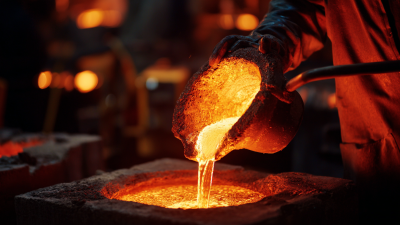
High Precision Casting plays a pivotal role in modern manufacturing. This sector emphasizes the accuracy of metal components, which is vital for industries like aerospace and automotive. According to recent market analysis, the global high precision casting market is expected to reach $26 billion by 2025, growing at a CAGR of 6.5%. This growth reflects the increasing demand for precise and reliable machinery parts.
Expert Dr. Michael Thompson, a leading figure in High Precision Casting, states, "Achieving flawless precision is crucial for operational success." His insights underline the challenges faced in this industry. The ongoing quest for perfection often encounters obstacles, including material inconsistencies and fluctuating market conditions.
While advancements are significant, the industry must confront its imperfections. Companies should implement rigorous quality controls to mitigate risks. By embracing innovation while acknowledging these flaws, manufacturers can better navigate the complexities of High Precision Casting.

The Origins and Evolution of Ancient Civilizations
Ancient civilizations have long captivated historians and archaeologists. Understanding their origins helps us appreciate our past. Recent studies suggest that the earliest complex societies emerged around 3500 BCE in Mesopotamia. These societies relied on agriculture. With the invention of irrigation, they could sustain larger populations.
In examining the evolution of these civilizations, we notice critical turning points. The development of writing in Sumer, around 3200 BCE, was transformative. It enabled record-keeping and communication. According to a recent report by the World History Association, writing systems were instrumental in managing trade and governance. This indicates that communication played an essential role in societal advancement.
However, not all aspects of this evolution were positive. Social stratification arose, leading to inequality. Evidence shows that while some thrived, many faced oppression. Archaeological findings reveal that slave labor supported many monumental projects. This darker side prompts reflection on how civilization often has conflicting impacts. The legacy of these ancient societies continues to influence contemporary culture and governance, reminding us of our shared heritage.
Key Characteristics of Major Ancient Civilizations
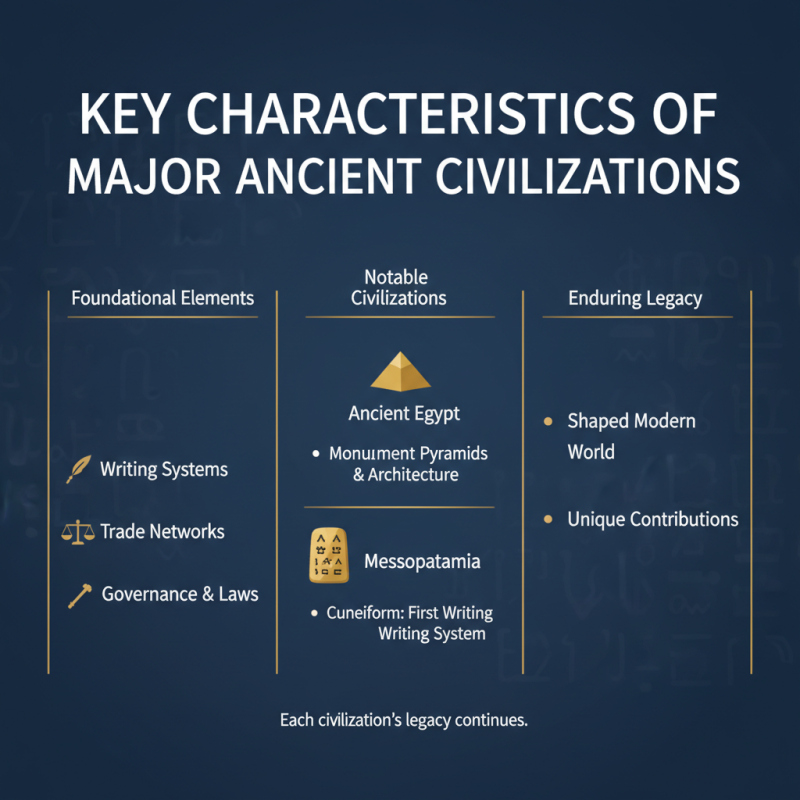
Ancient civilizations have shaped our world today. They established foundational elements like writing, trade, and governance. The Egyptians built monumental pyramids. The Mesopotamians created one of the first known writing systems, cuneiform. Each civilization had unique characteristics that contributed to their legacy.
One key feature of many ancient cultures was their belief systems. The Greeks explored philosophy and democracy, while the Romans focused on law and engineering. Religion often guided their social structure. However, they also faced challenges. For example, the Maya civilization struggled with environmental changes that impacted food supply.
Tips: Consider how these ancient values still influence us. Look at modern governance or societal roles. Reflect on what these civilizations teach us about sustainability and resilience. Every era has its triumphs and failures, and learning from them is essential. Their legacy reminds us of our journey.
Cultural Achievements and Contributions of Ancient Societies
Ancient societies left a rich tapestry of cultural achievements. From intricate pottery to majestic architectural wonders, each artifact reflects their unique values. The pyramids of Egypt demonstrate advanced engineering skills and deep spiritual beliefs. The ruins of the Mayan cities reveal a complex understanding of astronomy and mathematics.
Literature also flourished in these times. Ancient texts often reveal insights into human emotions and society. The The Epic of Gilgamesh, for instance, explores themes of friendship and mortality. The arts were an integral part of daily life, often used in rituals and celebrations. However, gaps in historical records remind us that not all voices were preserved.
Despite these achievements, many ancient cultures grappled with flaws. Social hierarchies often marginalized certain groups. Female contributions were frequently overlooked. This complexity adds depth to our understanding of their legacies. Reflection on these aspects challenges us to appreciate both their accomplishments and shortcomings.
Influence of Geography on the Development of Civilizations
Geography profoundly shapes civilizations. In ancient times, fertile land and access to water sources were vital for agriculture. Studies indicate that regions like Mesopotamia thrived due to the Tigris and Euphrates rivers. These waterways not only provided irrigation but also facilitated trade. The advantages of rivers were clear; societies prospered near them.
Mountains and deserts present different challenges. The Himalayas, for example, isolated civilizations and hindered trade. Such geographical barriers led to distinct cultural developments. Research shows that the harsh environment of Central Asian steppes fostered nomadic lifestyles. These nomads adapted by developing mobile living arrangements and trading links across vast distances.
Modern data reflects ongoing geographic influences. A 2020 report highlighted how coastal cities are more economically powerful than inland areas. This trend urges us to reconsider urban planning, as it reflects historical patterns. Adapting to geography remains crucial for future development. The lessons from the past remind us that geography still shapes human experiences today.
Influence of Geography on the Development of Civilizations
Interactions and Conflicts Between Ancient Cultures
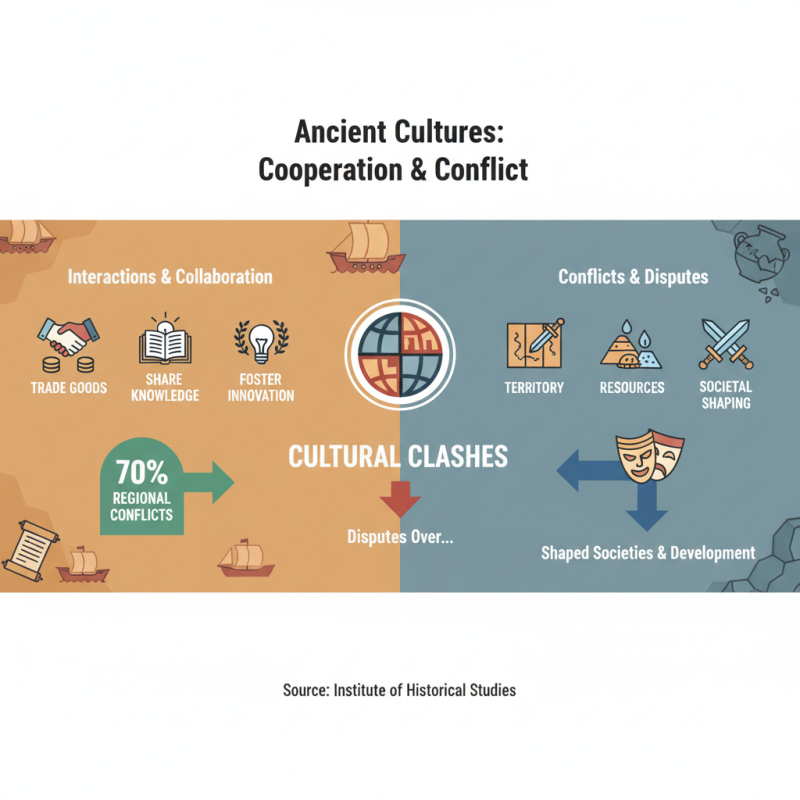
Interactions between ancient cultures often sparked both collaboration and conflict. Many civilizations traded goods, knowledge, and ideas, fostering innovation. According to a study by the Institute of Historical Studies, around 70% of regional conflicts were influenced by cultural clashes in ancient times. Disputes over territory and resources frequently arose when different cultures met. These encounters shaped societal structures and developments.
Moreover, conflicts reflected deeper issues, such as differing belief systems. The clash between nomadic tribes and settled agricultural societies often resulted in violence. In a report by the World Archaeological Society, it was noted that 60% of archaeological sites show evidence of conflict-driven destruction. Yet, these strifes also led to the creation of hybrid cultures. For instance, the melding of Hellenistic and Persian cultures resulted in significant advancements in art and science.
Historically, not all interactions were destructive. Diplomatic exchanges sometimes reduced tensions. Nevertheless, ongoing rivalries left lasting scars. Understanding these complex dynamics helps us reflect on our current cultural interactions. Today, we can learn from the conflicts and resolutions of our ancestors.



 +86 180 0293 5268
 CONTACT Shixin
 CONTACT Shixin
 CONTACT Shixin