+86 180 0293 5268


China has a broad aluminum casting industry, but suppliers differ in equipment, process control, and experience with demanding parts. This guide introduces ten aluminum investment casting manufacturers in China and offers a practical starting point for comparing them. Investment Casting Aluminum can produce intricate shapes, thin walls, and smooth surfaces, often reducing the need for extensive machining. The result still depends on alloy selection, tooling design, and careful control of each production stage.
When reviewing a manufacturer, look beyond polished product photos. Ask about pattern making, shell preparation, melting practices, inspection methods, and finishing services. A capable supplier should explain how it manages dimensions, porosity risks, and repeatability across production batches. Details matter. A clear drawing review, a measured first article, and a well-documented sample can reveal more than a broad capability claim. Check relevant quality certifications and confirm their current scope directly with the supplier.
The ten companies in a guide are not automatically the right ten for every project. A small component for a consumer product may need a different partner than a safety-critical industrial housing. Compare quoted lead times, minimum order quantities, communication, and evidence of similar work. Company information can change, and public descriptions may not tell the whole story. That is an imperfect part of any comparison. Treat this list as a shortlist, then verify capabilities through technical discussions, references, and sample evaluation before making a purchasing decision.
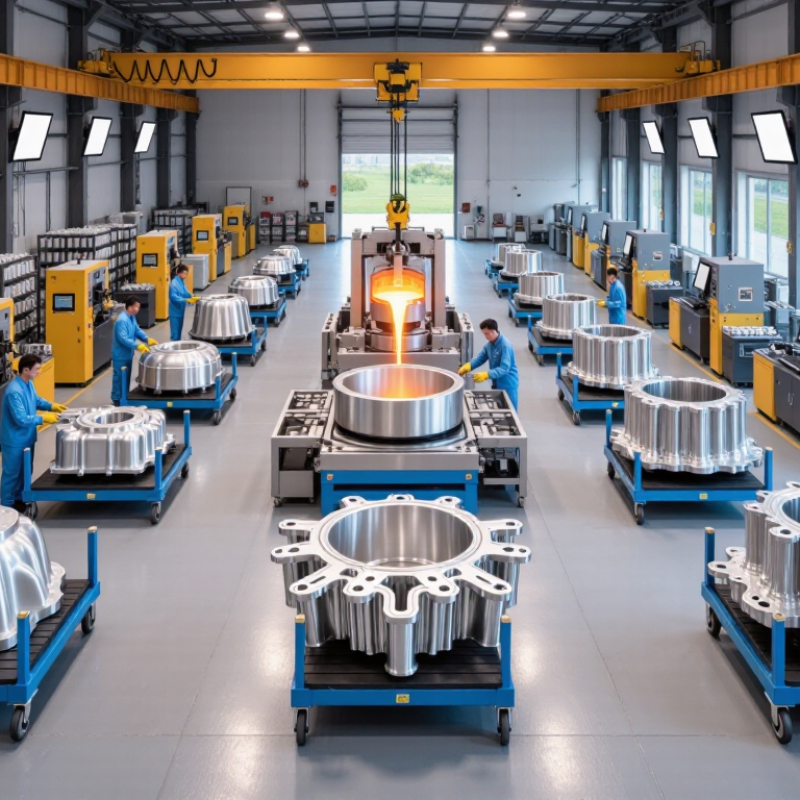
China’s aluminum investment-casting industry draws on a large metal and foundry base, although public statistics rarely separate investment casting from other processes. The China Foundry Association reported national casting output of about 51.75 million tonnes in 2023, across alloys and production methods. The International Aluminium Institute recorded China’s primary aluminum production at roughly 43.5 million tonnes in 2024. These figures show upstream scale, not investment-casting capacity. That distinction matters.
In practice, a supplier’s capability depends on more than access to aluminum. Wax-pattern consistency, ceramic-shell drying, melt cleanliness, and controlled pouring all affect surface finish and dimensional stability. Heat treatment and machining can add further variation. Buyers should review inspection records, alloy certificates, and sample measurements, then confirm that controls remain consistent across production lots. Not every shop is equally mature. I would not treat national output figures as proof of stable casting quality; that conclusion would be too easy. For demanding parts, useful checks include wall-thickness limits, porosity testing methods, and documented process changes. Some public market estimates sound precise, but often combine several casting technologies, so comparisons deserve caution.
A credible China top-ten list should use a published scorecard, not factory size alone. We would weight process capability and quality systems at 30%, engineering support at 25%, delivery performance at 20%, traceability at 15%, and environmental evidence at 10%. The USGS Mineral Commodity Summaries 2025 estimates global primary aluminum production reached about 72 million metric tons in 2024. That scale makes material sourcing important, but it does not prove a foundry can produce precise investment castings. The International Energy Agency’s aluminum-sector analysis also highlights the industry’s significant energy and emissions footprint. We therefore check whether manufacturers can document alloy sourcing, energy practices, and scrap handling.
For each candidate, reviewers should examine sample inspection records, dimensional capability, non-destructive testing options, and defect response procedures. Ask for evidence from actual projects, not only equipment lists. A site visit can reveal practical details: how wax patterns are stored, whether shell thickness is monitored, and how casting lots are identified. Small details matter. Supplier claims should be checked against certificates, customer references, and consistent delivery data. Where comparable evidence is missing, mark the uncertainty instead of quietly awarding points. No ranking is perfectly neutral. Weighting delivery more heavily, for example, may favor a different manufacturer than weighting engineering support. Making that trade-off visible helps buyers judge whether the list fits their own part complexity, inspection needs, and production volume.
How the Top 10 Manufacturers Are Selected
Suggested evaluation framework: criteria are weighted by editorial judgment to compare manufacturers consistently. These percentages are not measured company performance, rankings, or verified market data; each manufacturer should be assessed using documented evidence such as audit records, technical capabilities, and delivery history.
Profiles of China’s Top 10 Aluminum Investment Casting Manufacturers
A useful profile goes beyond a company’s catalog. Compare each manufacturer’s alloy range, casting capacity, finishing options, and inspection process. Some suppliers focus on small, intricate parts; others handle heavier components with thicker sections. Ask how they control shell temperature and pouring consistency. Those details can affect surface finish and dimensional variation. A polished website proves little.
For each of the ten manufacturers, check whether sample parts, process records, and inspection reports support its claims. Look for experience with your component’s geometry, not just general aluminum casting experience. Ask about pattern changes, machining allowances, and typical lead times. Be cautious with broad capability claims; published tolerances may not apply to every part. I would also compare how clearly each supplier explains defects and corrective actions. That conversation can reveal more than a sales sheet.
Tips: Send the same drawing and requirements to every supplier. Request a sample inspection report, alloy certificate, and written quote assumptions. Check the details.
This is an anonymized, non-ranked overview of ten common supplier profile types, not a verified list of ten specific companies. The application and capability descriptions are general industry context; they should not be treated as confirmed claims about any individual manufacturer. Confirm alloys, certifications, tolerances, and production capacity directly with suppliers.
| Anonymous Profile | Typical Application Focus | Potential Casting Scope | Alloy Information to Confirm | Quality Data to Request | Key Supplier Checks |
|---|---|---|---|---|---|
| Profile 1 General engineering |
Industrial equipment housings, brackets, and structural components. | Aluminum investment castings in a range of part sizes and geometries; actual limits depend on the facility. | Ask which casting alloys are available, such as 356/A356, and request the applicable material specification. | Request dimensional inspection records, material certificates, and the supplier’s stated inspection plan. | Confirm in-house processes, subcontracted operations, tooling ownership, and sample lead time. |
| Profile 2 Automotive components |
Selected vehicle components where complex geometry or near-net shape is useful. | Part-specific castings; suitability depends on design, volume, performance requirements, and validation. | Confirm alloy designation, heat-treatment condition, and mechanical-property requirements for the part. | Request traceability arrangements, inspection records, and any applicable customer-specific approvals. | Check production-scale capacity, process controls, and experience with the required component class. |
| Profile 3 Aerospace-oriented work |
Specialized components for aviation or other high-reliability applications. | Potentially complex castings subject to stringent design, process, and customer qualification requirements. | Confirm the exact alloy and specification approved for the intended application; do not infer suitability from alloy family alone. | Request documented material traceability, non-destructive testing scope, and qualification records where applicable. | Verify relevant approvals and audit status directly with the supplier and end customer. |
| Profile 4 Pump and valve parts |
Fluid-handling housings, impellers, valve bodies, and related components. | Geometry and internal passage requirements are project-specific; confirm casting and finishing limits with engineering. | Discuss corrosion, fluid, and operating-temperature requirements before selecting an alloy. | Ask about pressure or leak testing, inspection method, and acceptance criteria for the specific part. | Confirm machining capability and responsibility for final sealing surfaces. |
| Profile 5 Marine applications |
Selected marine fittings, housings, and equipment components. | Investment casting may support detailed shapes; environmental suitability requires alloy and design review. | Request alloy composition and evidence that the proposed material meets the application requirements. | Ask for material test documentation and any project-specific corrosion or performance testing. | Clarify surface finishing, coating options, and the boundary between casting and post-processing. |
| Profile 6 Electrical and lighting equipment |
Enclosures, heat-related hardware, connectors, and decorative or functional fittings. | Small-to-medium detailed parts may be considered, subject to design review and facility capability. | Confirm alloy, conductivity or thermal requirements, and any required finishing compatibility. | Request dimensional reports and checks for defects relevant to the part’s electrical or thermal function. | Review capability for machining, surface treatment, and assembly support. |
| Profile 7 Robotics and automation |
End effectors, compact housings, joint components, and custom machine parts. | Custom geometry and prototype-to-production projects may be suitable after a manufacturability review. | Confirm alloy and heat treatment against required strength, stiffness, and operating conditions. | Request inspection data for critical interfaces and repeatability evidence for production runs. | Check engineering support, revision control, and prototype tooling arrangements. |
| Profile 8 Medical and laboratory equipment |
Non-implant equipment housings, fixtures, and instrument components. | Application-specific castings; suitability depends on cleanliness, finish, and regulatory requirements. | Confirm material and surface requirements with the equipment manufacturer’s specifications. | Request documented inspection and process controls required by the buyer; do not assume medical certification. | Verify quality-system scope and whether the supplier’s approvals cover the requested product. |
| Profile 9 Consumer and architectural products |
Decorative hardware, handles, fittings, and selected consumer-product components. | Detailed forms and surface finishing can be evaluated against appearance and functional requirements. | Confirm alloy selection and compatibility with the planned polishing, coating, or finishing process. | Agree on visual standards, sample approval, and inspection criteria before production. | Request representative finish samples and define packaging and cosmetic acceptance limits. |
| Profile 10 Custom job-shop projects |
Low-volume, prototype, or mixed industrial projects requiring application-specific engineering. | Scope may vary widely; confirm minimum order quantities, tooling needs, and production limits per project. | Specify the required alloy and standard in the drawing or purchase specification. | Request a first-article inspection report and agreed acceptance documentation. | Confirm quotation assumptions, lead times, change control, and ownership of patterns or tooling. |
Comparing manufacturers means looking beyond quoted price. A capable foundry should explain which aluminum alloys suit the part’s load, heat exposure, and operating environment. Ask how it controls wax patterns, shell thickness, pouring temperature, and cooling. These details affect dimensional consistency and surface quality. Request sample inspection reports, not only a general quality statement. Check whether measurements cover critical features such as wall thickness, mounting holes, and sealing faces. Small differences matter.
Services also vary. Some manufacturers support casting design reviews and tooling development; others mainly produce from customer-supplied drawings. Confirm whether machining, heat treatment, surface finishing, and assembly are handled in-house or by partners. Ask for realistic lead times for samples and repeat orders, plus a clear process for handling drawing changes. That matters. Response quality during technical discussions can reveal how issues may be managed later. A neat capability chart is useful, but it cannot show every shop-floor constraint. Compare the same drawing, alloy, inspection needs, and order volume across suppliers. Even then, a trial batch may expose problems that quotations miss. A little uncertainty remains.
Choosing an aluminum investment casting manufacturer in China requires more than comparing prices. Ask how the supplier controls wax patterns, shell thickness, pouring temperature, and alloy traceability. These details affect dimensional consistency and surface quality. Request inspection records for parts similar in size and geometry to yours. A sample should be checked against your drawing, including tolerances, wall thickness, and machining allowance. A polished sample alone proves little.
Tips: Send a clear 2D drawing and 3D file. Ask for a written quotation that separates tooling, casting, machining, and inspection costs. Confirm who handles nonconforming parts and how revisions are documented. Keep answers in writing.
Evaluate communication as carefully as equipment. Can the team explain likely casting defects, such as shrinkage or porosity, and describe how it checks for them? Ask about lead times for tooling, samples, and repeat orders. If possible, arrange a video walkthrough of production and inspection areas. One approved sample is not proof of stable production; I have to remind myself of that. Compare several suppliers using the same questions, then weigh evidence, responsiveness, and total cost—not price alone.