+86 180 0293 5268


Choosing an Investment Casting supplier is not simply a matter of comparing unit prices. The right partner must turn drawings into repeatable parts while meeting material, tolerance, and delivery needs. Small details matter. A thin wall, deep internal passage, or tight machining allowance can affect tooling choices and inspection plans. Ask how the supplier reviews designs, controls wax patterns and ceramic shells, verifies alloy chemistry, and documents final dimensions. Evidence matters. Request sample inspection reports, process records, and clear explanations of corrective actions—not polished claims alone.
Yet no supplier is ideal for every project. A foundry experienced in stainless steel may not suit a complex nickel-alloy component or a short production run. Capacity, lead time, communication, and in-house machining all deserve practical review. Visit the facility when possible, or request recent production examples similar to your part. Listen for specifics. Vague answers about yield, traceability, or defect handling deserve follow-up. Price still matters, but the lowest quote can hide extra finishing, slower approvals, or costly variation. Compare total cost and risk, then confirm expectations in writing. The choice may involve trade-offs. Use this guide to assess a supplier’s actual capabilities, not just its sales language. A careful review can reveal gaps. It may also show that a good partner is not the cheapest, but the one whose processes fit your component and quality requirements.
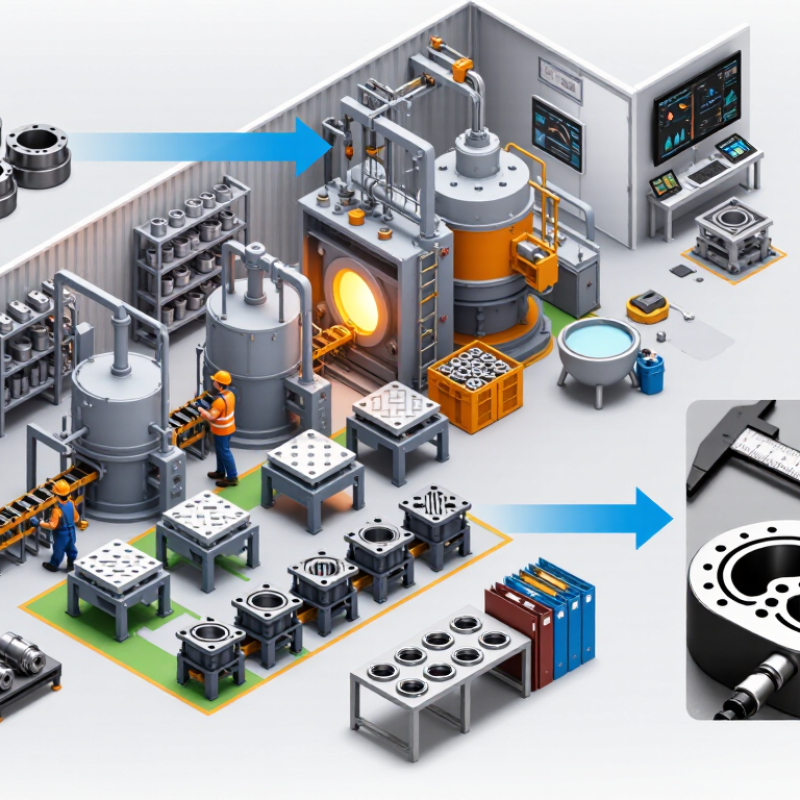
Investment casting turns a wax pattern into a metal component through a ceramic shell. The pattern is coated, melted out, and replaced with molten alloy. Once the metal cools, the shell is broken away. Gates are removed, and surfaces may be machined or finished. The process can produce complex shapes and fine details, but it is not ideal for every part. Small details matter.
A supplier does more than pour metal. They can review wall thickness, alloy choice, tolerances, and features that may cause shrinkage or distortion. A capable supplier explains trade-offs and identifies where machining or inspection may be needed. Ask how material batches are documented, which dimensions are checked, and how defects are handled. A checklist alone is not enough.
Before committing, review a sample part and an inspection report tied to your drawing. Confirm who approves design changes and how production issues are communicated. A neat quotation can feel reassuring, yet leave assumptions hidden around finishing, yield, or lead time. Discuss those assumptions early. Casting variation cannot be eliminated completely, so clear expectations matter. Remain open to revising the design when practical feedback reveals a weak point.

How to Choose the Right Investment Casting Supplier?
Identifying Your Part Requirements and Production Needs
Before comparing suppliers, define the part—not just its shape. Specify the alloy, operating temperature, load, corrosion exposure, critical dimensions, surface finish, and any inspection or traceability needs. Mark tolerances on the drawing where they matter; applying tight limits everywhere can add cost without improving performance. Include the expected annual quantity, batch size, prototype needs, and delivery schedule. Small details count. A thin wall or deep internal passage may affect casting feasibility and inspection.
Production scale matters, but figures need context. Modern Casting’s 57th Census reported 109.8 million metric tons of global castings produced in 2022. That total covers all casting methods, not investment castings alone. It does show how broad the foundry sector is—and why a supplier’s general capacity figure may say little about its experience with your alloy or geometry. Ask for examples of comparable parts, measured inspection results, and evidence of process control. Request a clear explanation of tooling ownership, sample approval, and how changes to drawings are handled.
Match the supplier’s process to your real demand. A design suited to repeat production may not be the best choice for a short run. Share forecast ranges rather than a single optimistic volume, and ask how lead times change with order size. Review sample parts against the same critical features listed on your drawing. One easy-to-miss gap: teams sometimes finalize tolerances before checking whether those features can be measured consistently. Revisit them with the supplier. It may feel slower, but it can prevent costly revisions later.
A capable investment casting supplier should demonstrate control across wax tooling, shell building, pouring, heat treatment, and inspection. Ask for recent examples using your alloy, part size, and tolerance range. ISO’s 2022 Survey recorded 1,265,216 valid ISO 9001 certificates worldwide. That figure shows how common the standard is, not how well one foundry controls its process.
Review sample inspection plans and actual records, not just capability claims. Check dimensional reports against the drawing, including critical areas such as thin walls, holes, and machining stock. Ask how the supplier monitors shell thickness, melt chemistry, and furnace temperature. For aerospace or other tightly controlled applications, confirm that approvals cover the specific site and processes involved. A certificate may not cover every operation.
Standards such as ISO 8062-3 can help clarify casting tolerances, while material and testing requirements should match the component’s service conditions. Request traceability from the melt lot to the finished part, plus nonconformance and corrective-action examples. Look for relevant non-destructive testing qualifications where inspection is required. Then speak with the engineers who will handle your parts. Paperwork matters. So does a candid answer about a past defect; I would want to know what changed afterward.
Use this supplier evaluation checklist to compare documented capabilities and evidence. Casting tolerances and process limits depend on part geometry, alloy, and specification; confirm them for each part rather than relying on a universal benchmark.
| Evaluation Area | Dimension | What to Verify | Useful Evidence or Evaluation Method |
|---|---|---|---|
| Manufacturing Capability | Part and process fit | Experience with comparable part geometry, required alloy, casting weight, wall sections, and production volume. | Review representative, non-confidential case studies or sample parts. Ask the supplier to assess the drawing and identify design or process risks. |
| Manufacturing Capability | Investment-casting process control | Controls for pattern or wax tooling, shell building, dewaxing, melting and pouring, knockout, cutoff, and finishing. | Request a process flow, control plan, and explanation of how critical parameters and process changes are recorded. |
| Manufacturing Capability | Alloy and material availability | Ability to produce the specified alloy and meet applicable material, heat-treatment, and customer requirements. | Check material specifications, melt practices, heat-treatment capability, and traceability from material or heat records to finished parts. |
| Manufacturing Capability | Dimensional capability | Ability to meet the drawing’s dimensions, geometric tolerances, surface requirements, and machining allowances. | Request a first-article inspection report and measurement records for agreed critical characteristics. Confirm measurement methods and equipment suitability. |
| Quality Management | Quality management system | Whether a documented quality system covers the actual manufacturing site and relevant casting activities. | Review a current ISO 9001 certificate and verify its scope, site, certification body, and validity. ISO 9001 specifies requirements for a quality management system; it does not certify an individual part. |
| Quality Management | Inspection and testing | Inspection planning for dimensions, visual condition, material properties, and any specified non-destructive testing (NDT). | Review inspection procedures, calibrated-equipment records, sample test reports, and evidence that any required NDT method is performed by qualified personnel. |
| Quality Management | Defect prevention and corrective action | How nonconformances are contained, investigated, corrected, and checked for recurrence. | Ask for a redacted corrective-action example showing root-cause analysis, containment, corrective action, and effectiveness verification. |
| Quality Management | Production performance | Consistency across production lots, on-time delivery, scrap, rework, and customer complaint trends. | Request recent, clearly defined performance data with the time period, calculation method, and product scope stated. Compare like-for-like measures. |
| Certifications and Approvals | Industry-specific quality requirements | Whether the customer or end-use sector requires a particular management-system approval or certification. | For automotive supply, check whether IATF 16949 requirements apply and verify certificate scope and site. For aerospace, check whether AS9100 requirements apply. Neither standard should be assumed necessary for every casting order. |
| Certifications and Approvals | Special-process approvals | Whether heat treatment, NDT, or another controlled special process must meet customer or industry-specific approval requirements. | Verify the specific approval or accreditation, covered process, site, and current status. Nadcap is an industry-managed accreditation program for specified special processes, not a universal requirement for investment casting suppliers. |
| Supply and Risk | Traceability and change control | Ability to trace parts through relevant production records and notify customers of approved changes to materials, processes, or site. | Ask for a sample traceability record and review procedures for record retention, lot identification, and customer notification of changes. |
| Supply and Risk | Capacity and continuity | Available capacity, tooling maintenance, backup plans, and management of supply interruptions. | Review capacity assumptions against forecast demand, tooling ownership and maintenance terms, and documented business-continuity arrangements. |
| Commercial Fit | Technical communication and quotation | Whether the supplier identifies drawing ambiguities, clarifies inspection requirements, and states tooling, lead-time, and pricing assumptions. | Evaluate the technical review and quotation for clearly documented assumptions, exclusions, deliverables, and proposed approval steps. |
When comparing investment casting suppliers, look beyond the quoted price. Ask for a cost breakdown covering tooling, sample parts, machining, inspection, packaging, and freight. A low unit price can hide expensive tooling changes or unclear charges for rejected castings. Check what tolerances and inspection methods the quote assumes. Small details matter.
Compare lead times by production stage, not by one promised delivery date. Request dates for tooling approval, first-article inspection, production, and shipping. Ask how the supplier handles a delayed sample or a change in order volume. A calendar promise is not a capacity plan. Communication matters just as much: identify who owns your order, how often updates arrive, and what happens when a milestone slips. A brief weekly update with dated photos can reveal more than a polished presentation.
Deloitte and MAPI’s 2024 Smart Manufacturing Survey found that 86% of surveyed manufacturing executives expected smart factory solutions to drive competitiveness over the following five years. That finding supports asking whether production updates reflect real shop-floor milestones. It does not prove a supplier will communicate well. I would still verify it; dashboards can look tidy while castings wait for inspection. Request a sample progress report and compare its dates with the supplier’s actual delivery history.
How to Choose the Right Investment Casting Supplier?
Verifying the Supplier Before Placing an Order
Before committing to an order, check that a supplier’s actual capabilities match your part. Ask to see the casting process, inspection equipment, and recent records for similar components. A floor visit can reveal practical details: how wax patterns are stored, whether work areas are organized, and how rejected castings are handled. A polished brochure is not proof.
Review the supplier’s quality documents, but verify what they cover and whether they are current. Request material certificates, sample inspection reports, and traceability records for a trial part. Confirm how critical dimensions and surface defects are measured against your drawing. Ask who approves process changes and how problems are reported. No checklist catches everything. Keep that in mind.
Tips: Send a representative drawing and ask the supplier to explain likely risks before quoting. Check references for comparable work, not just general satisfaction. Agree on sample quantities, inspection criteria, packaging, and delivery dates in writing. If answers stay vague, pause. A low quote can look attractive, but unclear controls may cost more later. Even careful checks leave some uncertainty; a small pilot order can expose gaps before production scales.
Suggested weighting for verifying a supplier before placing an order
Use these suggested weights as a starting point when comparing suppliers. Review process capability, quality records, technical fit, traceability, delivery capacity, and communication; adjust the weighting to match your part and project risks.